PerfuMate › AI Studio
It reads your shelf, not the internet
Describe what you want and AI Studio returns a complete formula, in grams, every line from a bottle you already own. What separates it from asking a chatbot for a perfume recipe is not the writing. It is that it is handed our catalog on every request (the odor description, the strength, the skin life and the dose ceiling for each of your materials) and that nothing reaches you until the arithmetic has been checked.
Five things it does
- BuildsA brief in, a complete formula out: pillars, the middle band, and the trace tail that makes it that perfume and not a generic one. Perfume or accord. It arrives named, with a percentage and a reason on every single line, and it will tell you plainly when what you asked for would make a weak perfume.
- AdvisesOpen a formula you already have and ask what is wrong with it. You get a real critique with numbers, not encouragement.
- RevisesA second tap turns that advice into a V2, saved as a new copy, with the original untouched. Advice you have to retype by hand is advice you will not use.
- RebuildsHand it a community formula, or a PDF from anywhere, and it recomposes the same idea from the bottles you actually own, saying for each swap how close it gets.
- AnswersAsk it a craft question and it answers as a perfumer: concrete percentages and material names, or one line if one line is honest.
What it is handed, bottle by bottle
The model is not trained on our catalog. It is given it.
A trained model carries a blurred memory of what it learned months ago. This one is handed the live rows, per request, for the materials on your shelf. So when the catalog is corrected, the next run is corrected with it, and there is no version of the data drifting along inside the model where nobody can reach it.
Every material you own travels with the following, up to a 350-material working set:
| The written odor description, in full | Not the first line of it. The second half is where the working detail lives: what a material fights with, how it behaves at a trace and at a full dose. That is what makes an answer fit a brief instead of merely sounding plausible. |
| Its olfactive family, and its facets under that | Placement down to facet level, so "smoky" can mean burnt cedar or pipe tobacco and the difference survives the trip. |
| Odor strength, 1 to 10 | Eight and up are trace-dose materials. Ten is the class where a single drop takes a formula over. |
| Its own hard ceiling, as a number on the row | Potent materials carry the exact figure the server will judge the answer against, in the same unit the answer comes back in. The model is not asked to derive a limit from a rating. |
| How long it lasts on skin, in hours | This is the longevity arithmetic. A twelve-hour brief is engineered from these numbers, not guessed from the word "base". |
| Top, heart or base | The tier it naturally occupies. |
| Its registry number | How the IFRA limits are matched. A registry number has no spellings, and a name does: this is the join that stops a real limit being lost to "Phenyl Ethyl Alcohol" against "Phenylethyl alcohol". |
| The dilution you keep it at | And every bottle strength you own of it, so the advice matches your weighing practice. |
| Where it sits on your shelf for cost | Cheap, mid or expensive, as terciles within your own shelf rather than a market price we do not know. |
| Whether that bottle is nearly empty | Fine for a trace; for a structural pillar it says so, or picks something else. |
Behind those rows sits the catalog itself: 2,211 materials, every one of them carrying a written odor description, 1,642 with a registry number, 314 flagged as restricted. Every odorous material carries a skin life, 898 of them from a sourced figure rather than an estimate from its family. You can read the whole thing without an account, and it is the same data the model gets.
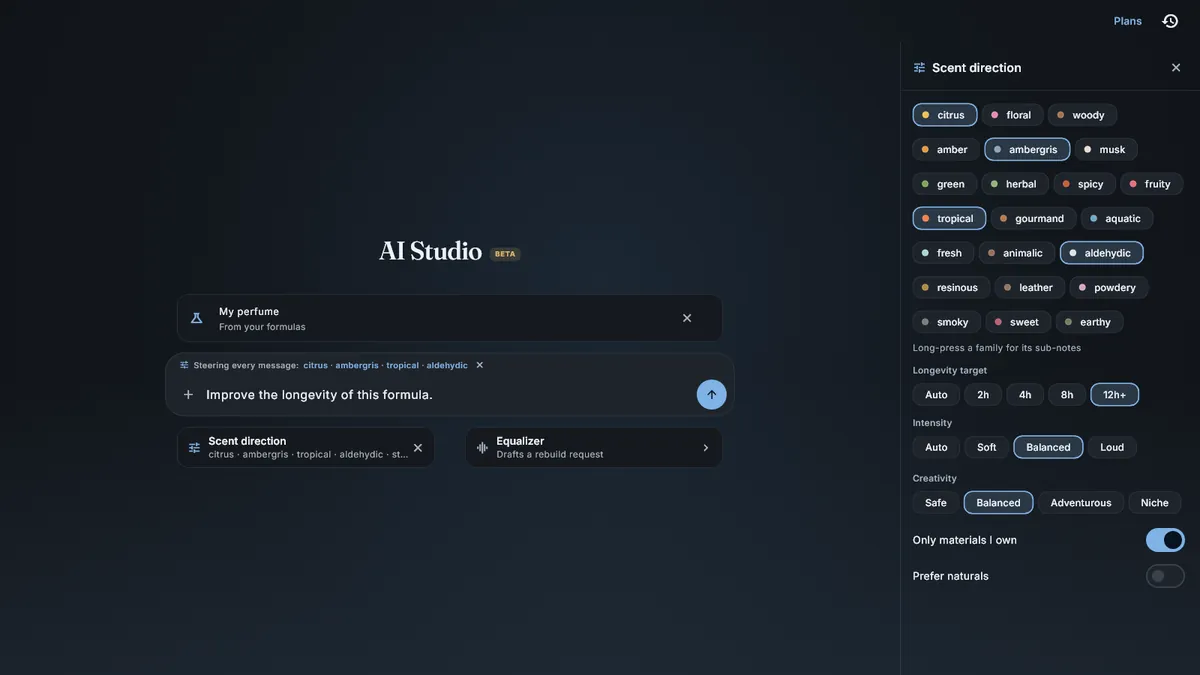
Scent direction
The brief is prose, but the direction is dials, and they steer every message you send rather than just the next one. Nothing here is required. Leave it all on Auto and you get a perfumer's own judgment.
Families, and their sub-notes
Tap a family to steer toward it; hold it and you pick the facets underneath, so "woody" can be sandalwood-creamy or cedar-dry.
Longevity target
Intensity
Creativity
And one switch
There is no switch for the shelf. AI Studio builds only from materials on your shelf, and that is enforced: a line naming anything else is rejected.
The drydown is arithmetic, not a mood
Ask for twelve hours and something has to answer for it. Every material's skin life rides in the payload, not its paper life. A formula carries the app's own reading with it (family shares, pyramid split, longevity, IFRA verdict), all computed before the model is asked anything. That is why its answer and your drydown chart agree.
Nothing reaches you unchecked
A language model under a creative brief will quietly break a rule stated in prose. So the rules are not prose on the way back. Every formula is validated before it is shown to you, and a failure sends it back to be done again inside the same credit:
- The shelf is enforced, not requestedA line naming anything that is not on your shelf is rejected outright. The model cannot invent a bottle you do not have.
- Potent materials are held to arithmeticA strength-ten material has a hard ceiling in percent, and the line is judged neat-equivalent: weighed from its own bottle strength and, for an accord, scaled by the dose that accord is used at. This exists because the model once overdosed a material a perfumer caught by hand.
- IFRA limits are walked all the way to skin291 Category 4 rows, matched by registry number rather than by name; the 252 that can be compared directly match the official IFRA PDF. A line is taken out through its bottle strength, the accord's share and how strong the finished perfume is worn, and then compared. Isomers that share one limit are totaled as a group rather than each getting the full allowance.
- A restriction we cannot quote is treated as a small oneWhere a material is flagged restricted but has no verified number to send, it is held to a trace rather than given the benefit of the doubt. A limit nobody can quote is a reason to dose small.
It is a reference, not a certification. The IFRA layer is built against the 51st Amendment for fine fragrance. It is there to catch the mistake you did not know you were making, and it is not a substitute for the standard itself or your supplier's documentation. The same is true of everything else here: this is a formulation tool, and you are still the perfumer.
What it will not do
It does not browse the web. Ask for a commercial perfume and you get an interpretation from your own shelf, never the original formula. It will not state an IFRA number from memory: no verified figure, no number. And it does not flatter: if the brief would make a weak perfume, it says so.
What it costs
AI Studio is optional, priced separately from Unlimited plans. A new full formula costs 10 credits. A new accord costs 7 credits. On an AI plan, questions use no credits. Direct editor actions are always free. Access and usage limits still apply. A technical retry of the same request does not charge again.
These are the prices at Instant, the default thinking level. Higher levels cost more: Balanced ×1.5, Deep ×2, Thorough ×3, Max ×5 (needs AI Studio Pro), rounded up to whole credits.
| AI Studio Basic | AI Studio Pro |
|---|---|
| 200 credits per week $8.99, billed monthly Cancel anytime Choose Basic | 500 credits per week $18.00, billed monthly $9 for your first month, then $18/month Cancel anytime Choose Pro |
Billed monthly, with fresh credits every week. Pro is 50% off for the first month only.
Billed once per calendar month. Credits refill every 7 days while paid access remains active. Unused weekly credits do not roll over. Plans renew monthly until canceled; cancellation stops future renewals, not access already paid for.
Already have an AI plan? Your existing plan, renewal price, billing schedule and paid benefits stay unchanged. Switching is optional.
Lab Mate is under construction. New purchases and trials are closed. It is not included in these new AI Studio plans. Existing paid Lab Mate access is preserved.
USD. Compare plans.
More on the same shelf: the catalog the model is handed, what happens to your data, what everything costs, and the beginner's guide if you have not made a perfume before.